

What is Homeschool Notebooking?
Notebooking is a natural part of a Charlotte Mason-inspired homeschool because it gives children a way to express what they have learned in their own words, pictures and ideas. Rather than filling in worksheets with answers they have copied from a textbook, children can respond to what they have read, observed or discovered by writing (or dictating) a narration, drawing a picture, labelling a diagram, recording an interesting fact or creating something of their own.
This makes notebooking much more than keeping a record of schoolwork. It gives children the opportunity to process ideas and make them their own. A younger child might draw a picture of an animal they have been studying and dictate a sentence about it, while an older child might write several paragraphs explaining what they remember from a living book, add a map, sketch an historical scene or record their own thoughts about an idea they have encountered.
In a Charlotte Mason homeschool, the emphasis is not on producing pages of perfectly presented work.
The important thing is that the child is thinking, remembering and communicating what they know.
Notebooking provides a simple, flexible way for children of different ages and abilities to do exactly that, while creating a personal record of their learning that becomes increasingly meaningful over the years. We encourage notebooking as well as the use of Mapwork and History Timelines in a Charlotte Mason-style homeschool.
The Benefits of Homeschool Notebooking Pages
1. Ideal for multi-age homeschooling
Many homeschoolers realise that they cannot import a school system into the home. Homes and schools function differently. In the homeschool there are many different ages, but one teacher. There are also different personalities that are being accommodated, as well as different talents, struggles and bents. Read more about Homeschooling Multiple Ages and how to juggle a variety of age levels.
2. A creative alternative to boring workbooks
Much of the learning in the school system is accomplished by a teacher presenting information through a textbook medium and children answering specific questions relating to that information. The answers can be in the form of multiple choice questions, true/false questions or short paragraphs in workbooks. At home, children can express what they have learned in a variety of other, equally or more effective ways, using drawing, writing or even dictation to a parent who acts as their scribe.
3. Effective tools for Charlotte Mason-style homeschooling using narration
At Footprints we encourage the practice of narration as explained by the renowned educator, Charlotte Mason. Narration is the “telling back” by the child to the parent about what has just been read or taught. The art of narration develops as the child grows in maturity and mental skill. The child’s narrative should be as close to the original content as possible, but this is an ability that children learn as they begin to pay full attention to the reading.
This is where the homeschool notebooking method can be used. A young child can draw a picture related to what has been read. An older child might like to draw a cartoon strip to narrate what she has learnt! Early writers may prefer to dictate their narration to a parent. More mature students can write longer narration using homeschool notebooking pages.
Often children like a combination of drawn and written narrations. Some children like to import clipart or use magazine pictures when notebooking. Our children love using glitter pens to add a little “zing” to their pages. In our article, Narration in a Charlotte Mason Homeschool, we explain why what happens in the brain and why learning becomes unforgettable, when children “make it their own”.
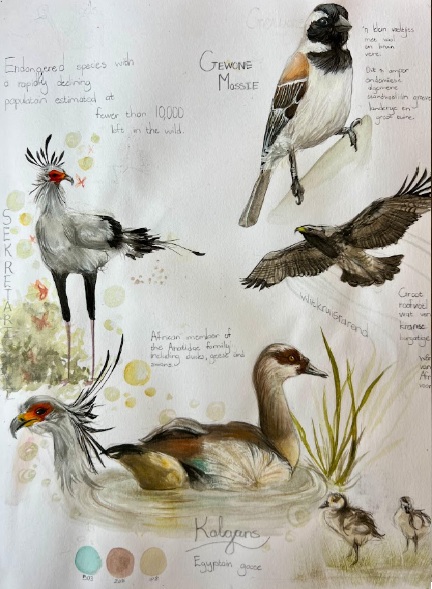
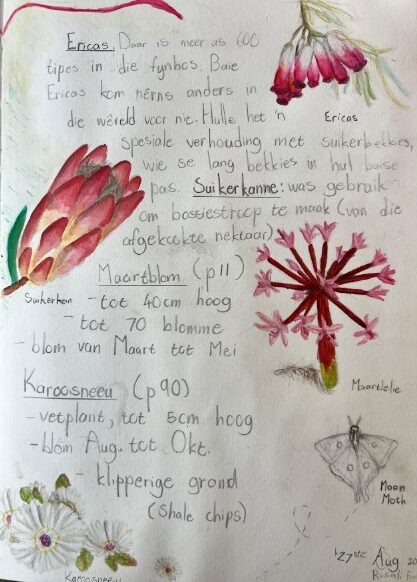
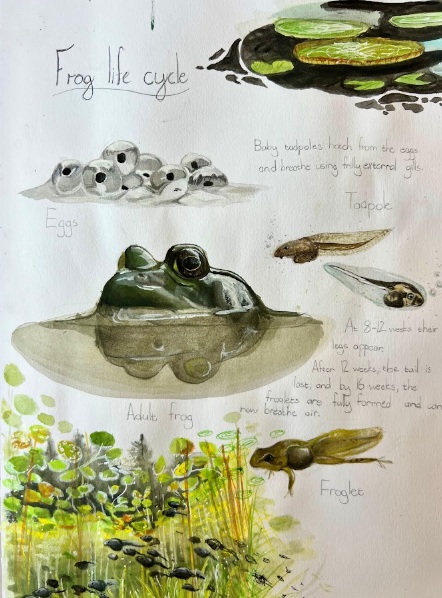
Above are examples of inspirational nature journal notebooking pages by an artistic Footprints student.
4. Useful for a wide range of subjects
Notebooking can be used for many subjects – history, geography, science – as well as for Bible copywork. Homeschool notebooking also works for nature study.
 |  |  |
5. Easy to store
Homeschool notebooking pages are easy to store, unlike some of your hands-on creations, which might be 3-dimensional and more bulky. (For those we recommend taking photographs for your records.) All your child’s notebooking pages can be filed in plastic sleeves with dividers per subject. These folders can become part of your children’s end of year portfolios from which you can choose some of the best pages across the disciplines to display.
6. Instantly available – just print
Since homeschooling notebooking pages are printable, you can find them in an instant, download, print and you can use them right away. No waiting for orders to be delivered. We have added some free printable notebooking pages to our website for you to use specific to South African studies.


We also offer printable Footprints notebooking pages that go along with our various Footprints programmes and Afrikaans language Notebooking Pages for Voetspore (Voetspore Werksvelle) to go along with the Voetspore Afrikaans South African literature-based unit study curriculum for ages 4-8 years.
If you like printable pages, also consider our South African history lapbooks.
Enhance Your Homeschool Journey with Printable Notebooking Pages
To help your children process what they are learning and express their discoveries in their own words and drawings, we offer custom printable notebooking sets designed to complement our core curricula.
Whether you are using our literature-based Footprints programmes or our Afrikaans Voetspore unit studies, these instantly downloadable pages provide a structured yet flexible space for narration, nature study, and project work. Provided for your convenience, they make it easy to encourage your children to take ownership of their learning while creating a beautiful, lasting record of their educational journey.


More about Charlotte Mason Homeschooling in South Africa
- Charlotte Mason Homeschooling in South Africa
- What is a Living Book? Why Living Books Teach More than Textbooks
- Narration in a Charlotte Mason Homeschool
- Homeschool Notebooking: An Alternative to Workbooks
- Mapwork in a Charlotte Mason Homeschool
- The Researched Advantage of Charlotte Mason Homeschooling in South Africa Today
- Charlotte Mason Timelines: Make History Come Alive
- The Benefits of Literature-based Learning
- Gentle yet Academically Rigorous: A Return to High-Quality, Personalised Education
- Why Do Nature Study?
- 6 Reasons Stories are Better than Textbooks
- Homeschooling Multiple Ages: How to Make Multilevel Homeschooling Work