
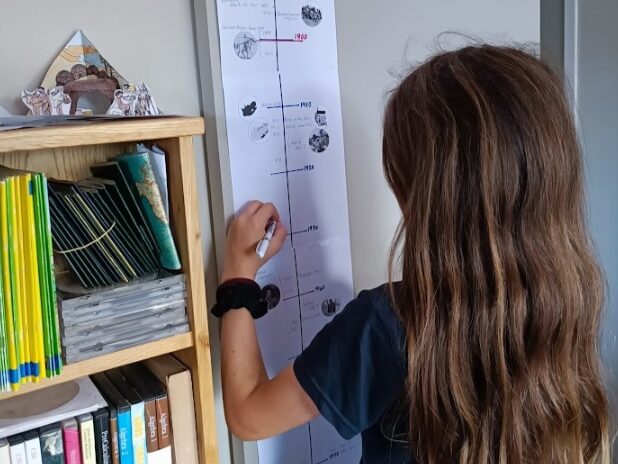
Charlotte Mason viewed the timeline as an ongoing, hands-on tool for mapping history. Rather than relying on tests, it demonstrates a student’s progress by showing how effectively they have learned from living books, connected historical eras and built a coherent understanding of the past.
History in the typical classroom can sometimes feel like a long list of names, dates and events that children are expected to memorise for a test. Charlotte Mason had a very different idea. She wanted children to develop a living relationship with history by meeting the people and events of the past through stories, books and ideas. A timeline is a valuable tool that helps children see history as a story unfolding through time rather than a collection of disconnected facts.
A History Timeline in a Charlotte Mason Homeschool
Charlotte Mason encouraged children to develop what she called a “sense of the past”. Rather than simply remembering dates, children gradually become familiar with people, places and events and begin to understand where they fit into the wider story of history.
A timeline gives those stories an anchor point in the past.
When a child learns about an important historical person, builds a model of a historical home or reads a story about an event from the past, placing it on a timeline helps him see how it relates to everything else he has encountered.
A timeline also makes history visible.
Instead of history disappearing into an exercise book once a lesson is finished, the timeline becomes something the child can return to again and again. Over time, the individual people and events begin to form a connected picture.
This fits naturally with the Charlotte Mason emphasis on living books, narration and the use of memory. You can read more about these elements of a Charlotte Mason education in our guide to A Charlotte Mason Homeschool.
A Timeline is More than a List of Dates
There is a temptation to turn a timeline into another memory exercise. Children copy dates, learn them by heart and move on to the next lesson.
That isn’t really the point.The timeline is there to help children understand when something happened and what else was happening at the same time.
For example, when a child learns about an important event in South African history, he can begin to see that it did not happen in isolation. Other events were taking place elsewhere in the world at the same time. A timeline helps bring those connections into view.
This is one reason we like to give children the opportunity to build and personalise their own timelines rather than simply handing them a completed chart.
The Footprints History Timeline Book
At Footprints, we have taken Charlotte Mason’s ideas about making history living and memorable and built them into our history programmes in a practical way.

You don’t have to design your own timeline from scratch or spend hours searching for suitable pictures and historical figures. Our Footprints history programmes include a timeline book designed for your child to fill in and personalise as he works through the programme.
As your child encounters people and events in the stories and living books, he can add them to his timeline, creating a visual record of the history he has actually studied. The timeline becomes a personal history book rather than another worksheet to complete.
We also provide picture discs featuring important historical personalities and events. These can be used alongside the timeline to give children a visual connection with the people they are meeting in their history studies.
In addition there is space to draw and dictate or write narrations about the topics each child has explored through stories.
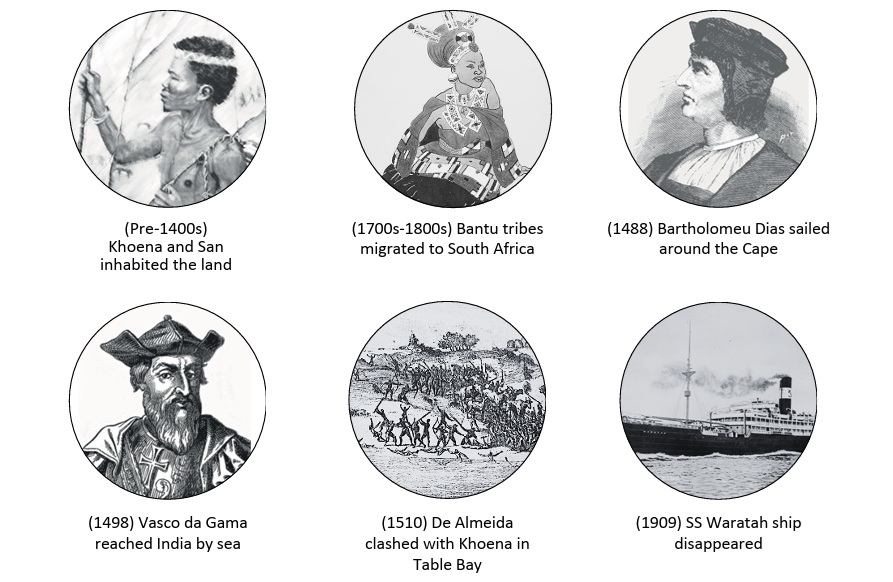
These resources are designed to make the Charlotte Mason approach practical for a busy homeschooling family. You can simply open your Footprints history programme, read the story together, talk about what you have discovered, narrate it and then add the relevant person or event to your child’s growing timeline.
Footprints families also use these picture discs on the wall maps they use for Mapwork in a Charlotte Mason Homeschool.

Bring the History Timeline onto the Wall
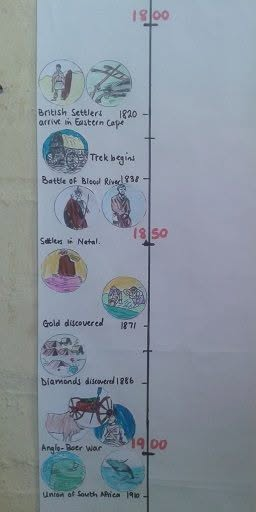
We encourage Footprints families to create a wall timeline in their homes.
There is something quite different about seeing history displayed on the wall day after day. A child doesn’t have to sit down for a formal history lesson to encounter it. He might walk past a date, recognise a familiar face or suddenly notice that two people he has learned about lived at roughly the same time.
The wall timeline can grow along with your history studies.
It doesn’t need to be elaborate or Pinterest-worthy. A long strip of paper, a section of wall or a series of cards can become a working history timeline. Add to it as your family encounters new people and events.
The important thing is that history becomes visible and familiar.
Make History Alive – Put Your Own Family on the Timeline
One of our favourite ways to make a timeline meaningful is to put your own family history on it too.
Alongside historical figures and events, mark the birth dates of parents, grandparents and other significant family members.
Suddenly history isn’t only about people who lived hundreds or thousands of years ago.
Your child can see that his grandmother was born during a particular period of South African history. He can see where his parents’ childhood fits into the wider story. He begins to understand that history did not stop before he was born. His own family is part of the continuing story.
This is particularly meaningful in South Africa, where our families may carry memories and stories from very different periods of the country’s history. A timeline can provide a natural starting point for conversations about those stories.
“Tell me about what life was like when you were a child.”
“What was happening in South Africa when Grandpa was born?”
“What do you remember about this event?”
These conversations can bring history to life in a way no worksheet can.
History Becomes an Ongoing Story We are Part Of
A Charlotte Mason education is not about rushing through a prescribed list of historical facts. It is about giving children the opportunity to encounter the people and stories that make up our shared past.
A timeline supports that approach beautifully.
At Footprints, we have taken Charlotte Mason’s ideas and adapted them for South African families, while providing practical resources that make it easier to put those ideas into practice. Our timeline books and picture discs (only sold as part of the Footprints and Voetspore programmes) give children something tangible to work with, while a simple wall timeline allows the whole family to keep history in view.
Most importantly, we want children to discover that history is not simply something that happened to other people, somewhere else, long ago.
It is the story of people. It is the story of our country. It is the story of our families. And, eventually, it becomes part of our own story too. Why Study the History of South Africa explains the importance of understanding who we are, where we come from and how our shared past shapes our lives today.
Our article, History is Boring. Your Heritage is Alive! describes how history becomes personal as children uncover their family and cultural heritage, connect with the past and discover their own place in South Africa’s story.
How to Make a Wall Timeline for your Homeschool
Here’s how to create a vertical wall timeline, using a fax roll.
We used ours to compare South African history on one side of the timeline with US history from 1450 onwards. We studied the two countries in two consecutive years, focusing on each country for a year at a time. Our timeline was from 1450 to beyond 2000 and stretched from ceiling to floor level.
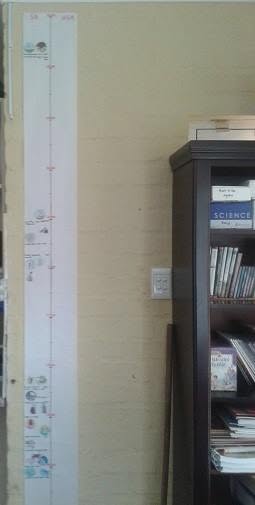
Instructions
1. Roll the fax paper out onto a clean floor. Weigh it down with books so it won’t curl up. Alternatively, instead of using a fax roll, you can simply tape or glue A4 pages together to make a long strip.
2. Starting at the edge of the paper, using a pencil, mark off increments of 20cm for every 50 years, starting at 1450.
3. Cut the timeline off the fax roll once you have passed 2000.
4. Using a long ruler, draw a vertical line down the middle of your timeline
5. Using a marker, label every 50 years: 1450, 1500, 1550 etc
6. Plot your important dates and events. Add picture discs or thumbnail pics to highlight people or events as shown in the image above.
Let your children mark off significant dates and write a brief note next to each date. Use a thick felt-tipped marker that can be read from far off. Then stick on the appropriate picture disc, which you may photocopy for your own use (available at the back of this manual). Another option is to let your children draw their own picture discs. This may be a more meaningful exercise. Whatever you decide, by using these visual aids, you will soon find that the whole family will be learning names and dates!
Time Travel Boardgames
Step back into history with TimeTravel, an exciting game that tests your knowledge of 600 years of human development in South Africa and around the world.
Time Travel (or Tyd Toer in Afrikaans) is a unique South African boardgame that teaches both South African and world history. The aim of the game is to build your own timeline by placing nine historical events cards in the right chronological order before your opponents do. But beware: if you make a mistake on your timeline, you will have to restart!


More about Charlotte Mason Homeschooling in South Africa
- Charlotte Mason Homeschooling in South Africa
- What is a Living Book? Why Living Books Teach More than Textbooks
- Narration in a Charlotte Mason Homeschool
- Homeschool Notebooking: An Alternative to Workbooks
- Mapwork in a Charlotte Mason Homeschool
- The Researched Advantage of Charlotte Mason Homeschooling in South Africa Today
- Charlotte Mason Timelines: Make History Come Alive
- The Benefits of Literature-based Learning
- Gentle yet Academically Rigorous: A Return to High-Quality, Personalised Education
- Why Do Nature Study?
- 6 Reasons Stories are Better than Textbooks
- Homeschooling Multiple Ages: How to Make Multilevel Homeschooling Work