
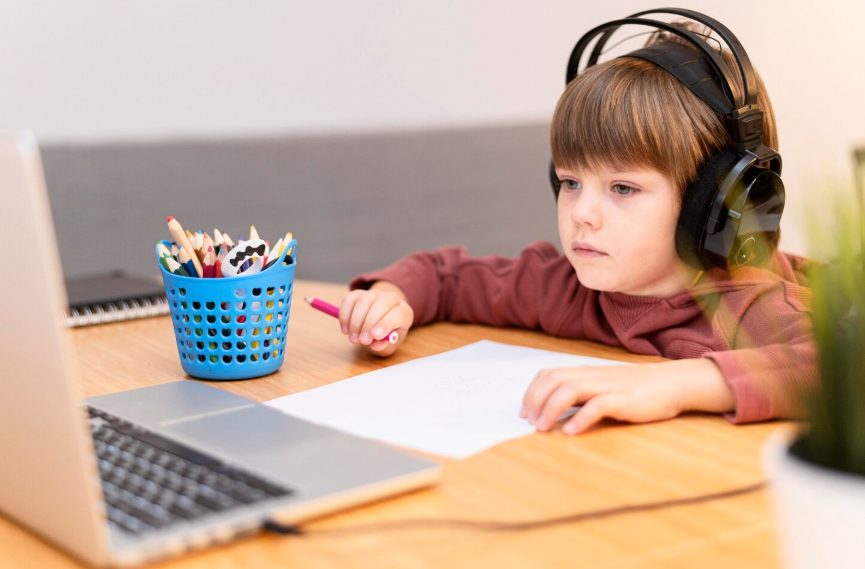
Online schooling might seem convenient but it comes with serious trade-offs that parents should consider. You need to understand the risks versus benefits so that you are better equipped to make an informed choice.
One of the most common questions we see from new homeschool parents with young children is this:
“My son is currently in grade X and is homeschooled. I would like to enrol him into an online platform instead. What do you recommend?”
We understand why this feels like a sensible and convenient next step.
Online platforms promise structure, independence and relief for the parent who may feel uncertain about whether she is “doing enough.” They offer pre-recorded lessons, automated assessments and the reassuring appearance of a complete education package neatly delivered through a screen.
For a busy mother, especially one juggling multiple responsibilities, this can feel like a lifeline.
However, convenience is not the same as suitability, particularly when it comes to young children.
Stop and ask yourself honestly if your motivation to switch to online schooling is due to the benefit you see for yourself or is it truly for your child?
The Hidden Cost of Screen-Based Learning
Children in the primary grades and early teens are still developing in significant ways, cognitively, emotionally and physically. When learning becomes primarily screen-based, several concerns arise that parents often overlook in the appeal of convenience.
1. Reduces Attention
Firstly, extended screen time reduces attention span rather than building it. Digital platforms are designed to keep users engaged through stimulation, not depth. This makes it more difficult for children to develop the kind of sustained focus required for deep thinking, reading and problem-solving.
2. Passive Consumption
Secondly, passive consumption replaces active engagement. Watching lessons, clicking through quizzes and completing automated tasks may create the impression of productivity, yet it often lacks the richness of true learning. Children may remember information for a short time, but they are less likely to internalise it or connect it meaningfully to the real world.
3. Reduces Human Connection
Thirdly, and perhaps most importantly, screen-heavy learning reduces human connection. We consider this as the greatest loss to both you and your children.
Education, especially in the formative years, is not merely about content delivery. It is about relationships, conversation, curiosity and shared discovery. These elements cannot be replicated by a platform, no matter how advanced it may be.
No screen can replace YOU and the time you invest with your children and their learning journeys.
The Physical Health Cost of Screen-Based Learning
Another important aspect to consider is the physical toll of screen-based learning on a growing child’s body. When much of the school day is spent seated in front of a device, natural movement is reduced and with it the many benefits that come from regular physical activity such as improved concentration, emotional regulation and overall health.
Over time, this sedentary pattern can lead to restlessness, poor posture and a decreased ability to focus for extended periods.
There is growing evidence that excessive screen time is linked to an increased risk of myopia (short-sightedness) in children, although it is not the only factor involved.
Myopia develops when the eye grows too long, causing distant objects to appear blurry. Research suggests that prolonged close-up focus, such as reading on screens, tablets or phones, may contribute to this process. When children spend many hours looking at things up close, their eyes adapt to that focus and over time this can increase the likelihood of developing myopia.

What Screen Time Replaces
However, what appears to matter even more is what screen time often replaces.
Children who spend large amounts of time on screens tend to spend less time outdoors, and this is significant. Exposure to natural daylight has been shown to play a protective role in eye development. Regular outdoor time helps regulate how the eye grows, reducing the risk of myopia. In other words, it is not only the screen itself, but the loss of outdoor play and distance viewing that contributes to the problem.
There are also practical concerns. Screens encourage sustained focus at a fixed, close distance, often without breaks. This can lead to eye strain and may reinforce habits that place additional stress on developing eyes.
A balanced way to think about it is this:
Screen time is not the sole cause of myopia, but high levels of screen-based, close-up activity, combined with limited outdoor time, do increase the risk.
For growing children, especially in the primary and middle school years, it is wise to prioritise:
- plenty of time outdoors in natural light
- regular breaks from near work
- a variety of activities that involve looking at different distances
This perspective fits closely with what we advocate in a Footprints approach, where learning is not confined to a screen and where movement, exploration and real-world engagement form a natural part of the child’s day. Our article, Why do Nature Study? explains more of the benefits of being out of doors.
The Illusion of Independence
Many parents are drawn to online schooling because it appears to foster independence. The child logs in, follows the programme and works through tasks with minimal parental involvement.
Yet this is often a premature, superficial independence.
True independence is built gradually, through guided learning, discussion and the development of thinking skills. When a child is left to navigate their education primarily through a screen, they may become compliant rather than capable, completing tasks without truly understanding or questioning what they are learning.
Independence is not about working alone. It is about learning how to think.
A Different Approach: Story-Driven Learning
At Footprints, we offer families a very different but highly effective and engaging learning experience.
Our approach is rooted in story-driven learning, which may seem simple on the surface, yet it is profoundly productive in shaping how children think, connect and grow.
Stories engage the imagination in a way that screens cannot. They invite children to step into different worlds, to understand people, places and ideas, and to make sense of complex concepts through narrative. 6 Reasons Stories are Better than Textbooks explains more.
More than that, stories create a shared experience between mother and child.
When you sit together and read aloud and discuss and explore a story, something far deeper than academic learning takes place. You are building connection. You are developing curiosity. You are creating a space where questions are welcomed and ideas are explored without pressure.
These moments can’t be automated or outsourced.
The stories and related assignments and activities become part of your child’s memory. The consistent routine of learning together, the conversations that wander beyond the page and the laughter you share are among the many bonuses. For your child, a sense of being seen, valued and guided are priceless.
We also recognise that no homeschool situation is perfect. We all fall short of our lofty ideals, but many of us fail to recognise that there is also ‘gold’ to be mined in our less-than-perfect homeschool scenarios. Read Mining the Gold in Your Homeschool Situation
Learning that Sticks
Story-driven learning also leads to better retention and understanding. Our article How to Ensure Deep Learning in an Age of Digital Distraction explains what happens in our brains when we hear stories and why the learning sticks! Our human brains are “wired for stories”!
Children remember stories far more easily than isolated facts. They begin to see patterns, relationships and meaning. History becomes a story of people rather than a list of dates. Science becomes an exploration rather than a set of definitions and language skills develop naturally through rich exposure, instead of repetitive drills and exercises.
This kind of learning is not only more enjoyable for both you and your child, it is highly effective. Here’s what modern neuroscience and education research confirm about the approach we advocate: The Researched Advantage of Charlotte Mason Homeschooling in South Africa Today
A Thoughtful, Informed Choice
We are not suggesting that online platforms have no place at all. For older students, or in specific contexts, they can serve as a useful tool.
However, for younger children, especially those in the primary school years, we encourage parents to think carefully before handing over their child’s education to a screen.
The years you have now are precious. Don’t miss The Hidden Blessing of Homeschooling
They are an opportunity not only to educate your child but to build a relationship that will carry into the teenage years and beyond. Choosing a more personal, more connected approach may require more presence from you as a mother, yet it offers great dividends in return.
Choosing Connection over Convenience
It is natural to look for systems that make homeschooling easier. However, the goal is not simply to make education more convenient. The goal is to make it meaningful.
Before you move your child onto an online platform, ask yourself what kind of learner you want to raise and what kind of relationship you want to build.
In our experience, the richest learning does not happen through a screen. It happens on the couch with a book, around the table in conversation and in the shared journey of discovery that unfolds when a mother and child learn side by side.
Our article, Footprints vs. CAPS: What’s the Difference for South African Homeschoolers explains how online schooling and CAPS (the national curriculum) stifle learning and the benefits of an approach that values your child’s uniqueness instead.
We know that no one chooses home education because it’s easy, but rather because we believe that it’s worth the investment of time and energy into shaping our children’s lives.
If you could use a little reassurance, perspective, and peace in your inbox, sign up today, because sometimes, the smallest words of encouragement are exactly what keep us going.
Join the Footprints community and get your Nurture Nuggets today, packed with tips and advice from moms with over 25 years of home education experience.
Sign up today, so you don’t miss the next issue.