

Homeschooling multiple ages doesn’t have to be overwhelming. Learn practical strategies for multilevel homeschooling and discover how Footprints helps siblings learn together.
Homeschooling one child can feel fairly straightforward. Homeschooling two or three children at different ages is another story.
One child needs help learning to read. Another is asking for help with Maths. An older child is working independently but still needs you to explain something. Meanwhile, the toddler has decided that your carefully planned lesson is the perfect time to build a fort underneath the dining room table!
If you are homeschooling multiple children, you may sometimes wonder:
How am I supposed to teach everyone without spending the entire day running from one child to another?
The good news is that you don’t need to teach every child separately.
In fact, one of the great advantages of homeschooling is that you can stop trying to recreate the classroom model of one teacher, one grade and one textbook. Our article School-at-Home versus Eclectic Homeschooling explains how you can and should be create a more flexible, customised style of learning at home.
Instead, you can build a multilevel homeschool where children of different ages learn together where it makes sense, work independently where necessary and contribute to the family learning experience at their own level.
That is one of the principles behind Footprints. We the authors of Footprints are both mothers of large families, so we’ve lived it! Read the rest of this page and watch our short video clip with our tried-and-tested tips for Homeschooling Multiple Grades:
What is multilevel homeschooling?
Multilevel homeschooling, sometimes called multi-age homeschooling or homeschooling multiple ages, is simply the practice of educating children of different ages together rather than following a completely separate curriculum and timetable for every child.
This does not mean that every child does exactly the same work. It means that you look for the places where learning can be shared.
For example, your 6-year-old, 9-year-old and 12-year-old might all listen to the same story about South African history.
They can discuss the story together. They might look at the same map. They might listen to the same music, examine the same artwork or take part in the same hands-on activity but their written work, reading, research and expectations can be completely different.
The younger child might draw a picture. The middle child might write a paragraph. The older child might research the historical context and write a longer report.
One topic. Different levels of learning.
That is the heart of multilevel homeschooling.
You don’t have to teach every child every subject separately
One of the biggest mistakes parents make when they begin homeschooling several children is assuming that each child needs their own complete programme for every subject.
If you have four children, that can quickly become four Maths programmes, four History programmes, four Science programmes, four English programmes and four completely different schedules.
Before long, you will be spending more time managing the curriculum than educating your children.
Instead, divide your subjects into two broad categories:
Subjects that are usually individual
Some subjects need to be taught at the child’s own level. These often include:
- Maths
- Reading instruction
- Spelling
- Handwriting
- Some aspects of language learning
- Work that depends on a child’s particular skill level
These subjects can be done individually or in small groups.
Your 7-year-old does not need to wait for your 12-year-old to finish Algebra before starting Maths.
Likewise, your older child may need more advanced work while the younger child is still learning basic number concepts.
Subjects that can be shared
Other subjects lend themselves beautifully to learning together.
These might include:
- History
- Geography
- Nature study
- Science
- Literature
- Art
- Music
- Bible
- Cultural studies
- Projects
- Cooking
- Handicrafts
- Educational outings
We include all of these in our various Footprints programmes. This is where multilevel homeschooling becomes particularly powerful.
Instead of teaching three separate history lessons, you can gather everyone together and tell one story. Then you adjust what each child does with what they have learned.
The secret is not keeping everyone at the same level
A multilevel homeschool does not require your children to be at the same academic level.
It requires you to recognise that children can learn from the same material at different levels of complexity.
Imagine that your family is learning about the Anglo-Zulu War.
- Your youngest child might listen to a story and draw a picture of what happened.
- Your middle child might locate the places involved on a map and write a few sentences about the battles.
- Your older child might read a biography, research different perspectives and write a report.
Everyone has learned about the same historical event.
But nobody has been forced into exactly the same assignment.
This is one of the reasons Footprints does not work according to rigid grade levels. The programmes are designed around broad age ranges, allowing siblings within the same general stage to share learning while adapting activities and expectations for individual children.
Start the day together
One of the simplest ways to make homeschooling multiple ages manageable is to begin with something everyone can do together.
Perhaps you gather around together for:
- A read-aloud
- Bible reading
- Poetry
- A history story
- Geography
- Nature study
- Music appreciation
- Art appreciation
This creates a shared rhythm for the family. It also means that you are not constantly moving between separate rooms trying to teach separate lessons.
Once the shared lesson is finished, the children can move into their individual work.
The younger children might practise reading while the older children work on Maths.
Later, you can swap your attention from one child to another. The goal is not to have everyone working independently all day. The goal is to use your time together wisely.
Teach the child who needs you most
A good tip is to do something with the youngest child first, especially if you have a toddler. Fill that child’s “love tank” by giving him or her your undivided attention for a few minutes. You can look at a picture book together or build something with blocks. Once the child has had your attention, you’ll probably be able to leave him or her to play quietly while you focus on the older bunch. Watch our video clip with more tips for homeschooling with a busy toddler:
When you have several children, someone will always need you. That is normal.
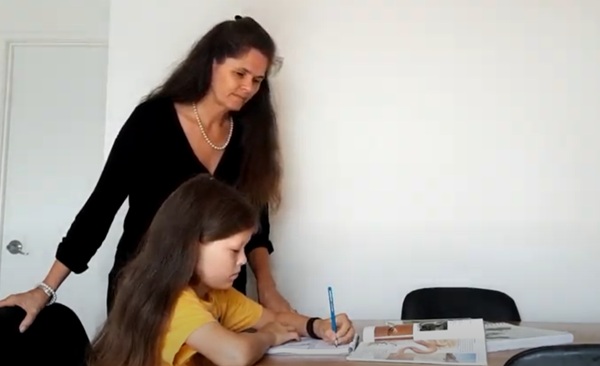
You may sit down with your 7-year-old to help with reading, only to hear: “Mom, I don’t understand this Maths question!” from the other side of the room.
You cannot always respond immediately and your children have to learn to wait or do what they can without you.
One of the skills children develop through homeschooling is to work independently and solve problems without having an adult beside them every minute.
This takes time.
An older child who initially needs you for every instruction may eventually learn to read the lesson, attempt the work and mark the questions they don’t understand for you to deal with later.
Your younger children will also gradually develop the ability to occupy themselves productively and sometimes an older child can keep the toddler from interrupting the other children’s activities.
Independence is built, not expected.
Give younger children permission to play
This is particularly important when there is a large age gap between your children.
You do not have to make your 4-year-old participate in everything your 12-year-old is doing.
Sometimes the best thing your younger child can do while you work with an older sibling is play.
- Build with blocks.
- Draw.
- Look at picture books.
- Play outside.
- Make something.
- Dress up.
- Explore.
- Play with a sibling.

Young children learn through play and they do not need a formal worksheet to be learning.
Trying to keep a four-year-old academically occupied for the entire school day can create unnecessary pressure for both mother and child.
Your homeschool does not have to look like school.
Here are Preschool Ideas for homeschoolers.
Let siblings learn from each other
One of the greatest benefits of homeschooling multiple ages is something you cannot easily reproduce in a conventional classroom.
Your children can become teachers to one another. An older child can read to a younger sibling. A younger child can ask surprisingly insightful questions and a middle child can demonstrate something they have just learned.
Children can work together on a project, game or practical activity.
This develops more than academic knowledge.
It develops:
- Patience
- Communication
- Leadership
- Responsibility
- Cooperation
- Problem-solving
- Confidence

It can also strengthen sibling relationships. Learning together becomes part of family life rather than a series of isolated lessons.
Don’t try to keep everyone busy
There is a subtle difference between learning and being occupied.
When you have several children, it can be tempting to create a long list of activities simply to keep everyone busy while you teach someone else but your goal is not to fill every minute. Your goal is to create an environment where your children can learn, explore and gradually become independent.
Some days will be full of activities. Other days may involve little more than reading books, finishing Maths, going for a walk and pursuing an unexpected question that has captured everyone’s attention.
That is still education.
Use a curriculum that is designed for homeschooling multiple ages
This is where the choice of curriculum makes a huge difference. A traditional grade-based curriculum assumes that every child is working through the same material at a particular grade level. That can make homeschooling several children unnecessarily complicated. Our article, Choosing the BEST Curriculum compares choosing curricula for a large family with buying cars. We know first-hand that the needs of large families are not like other families!
Instead of asking: “What does my Grade 3 child need to do?” you can ask:
“What are we learning about as a family, and how can each child engage with it at their own level?”
Footprints was created with this kind of learning in mind.
The programmes are literature-based, unit-study programmes covering broad age ranges rather than one grade at a time. Children can share stories, history, geography, literature, art, music and hands-on activities while completing work appropriate to their own abilities.
The current Footprints programmes are aimed at three broad age groups with overlaps to cater for homeschool multiple ages together:
- 4-8 years
- 8-14 years
- 10-16 years
You can see how the programmes fit together on the Footprints Learning Pathway.
What if my children are in different age groups?
This is where you need to be realistic when homeschooling multiple ages.
If you have a 5-year-old, a 10-year-old and a 15-year-old, you probably won’t be doing exactly the same programme with all three.
You don’t need to. Instead, look for overlap.
Your 10-year-old and 15-year-old might share some history and literature. Your 5-year-old might join the family for stories, nature walks and some activities. Your older children can work on increasingly independent assignments while your youngest has a different level of work.
The aim is not to make your children’s ages disappear.
The aim is to make the overlap between their ages work for you.
Here are suggested curriculum combinations for various grade levels, but even here you can be flexible.
Personalised Homeschooling: Grades 1-3
Personalised Home Education: Grades 4-7
What about Maths and Languages?
These are often the subjects that cause the most stress with homeschooling multiple ages… and for good reason.
It is much harder to teach three children different Maths concepts simultaneously than it is to read a history story to three children.
Don’t feel that you need to force these subjects into a family learning model.
Work with each child at their own level.
One child might work independently while you spend 15 minutes teaching another. Then you swap. Sometimes you flit like a butterfly from one child to another, overseeing or helping them with their tasks.
You can also teach children to wait while you finish helping a sibling.
Over time, they become increasingly independent.
The Footprints approach similarly recognises that children do not need to be at the same level for every subject. We recommend shared multi-age learning for subjects such as Social Studies while recognising that Maths and Languages need to be approached according to individual ability.
Here are the products we recommend for homeschooling these subjects:
Afrikaans Language Arts
English Language Arts
Maths
Don’t let the curriculum become your master
This may be one of the most important principles of multilevel homeschooling.
The curriculum is a tool. It is not your slave master.
If an assignment takes too long, simplify it. If your children are fascinated by a particular topic, delve deeper and explore it until their curiosity is satisfied. One of Wendy’s children was captivated by horses for a season, another child was fascinated by birds and delved in ornithology.
If everyone is tired, stop. If you need a catch-up day, have one. We often schedule a mid-term week’s break.
If one child needs extra help, give it.
If an activity is wonderful for your 12-year-old but completely inappropriate for your 6-year-old, don’t make the younger child do it.
A curriculum should make family life easier, not turn your home into a miniature classroom.
Footprints was created by homeschoolers with this flexibility in mind. Its programmes are designed to give parents stories, resources and lesson ideas while allowing them to adapt the experience to their own families.
Your homeschool does not have to be perfect
When you homeschool multiple ages, there will be days when somebody is waiting. There will be unfinished work. There will be interruptions. There will be babies who cry, toddlers who spill things and children who suddenly need you at exactly the same moment.
There will be days when the carefully planned schedule falls apart before breakfast.
That doesn’t mean your homeschool is failing.
It means you are homeschooling a family. Most often, the disruption is the lesson! As we often say, some of the most valuable lessons are not found within the pages of books, but by living life alongside you.
The beauty of homeschooling multiple ages is that your children are not simply progressing through separate academic programmes.
They are growing up together.
They are listening to the same stories.
They are learning from one another.
They are developing relationships.
They are discovering the world together and you are building an educational experience around the actual people who live in your home.
Five principles for successful multilevel homeschooling
If you remember nothing else, remember these five principles:
1. Teach together where you can
Look for subjects and experiences that naturally lend themselves to family learning.
2. Teach individually where you need to
Maths, reading and language skills often need to be taught according to each child’s ability.
3. Adjust the expectations, not necessarily the topic
The whole family can learn about the same subject while producing completely different work.
4. Allow children to become independent
They don’t need you beside them every minute. Independence develops gradually.
5. Protect the joy of learning
If your schedule, curriculum or expectations are making everyone miserable, something needs to change.
Multilevel homeschooling can become one of your greatest strengths
When you first start homeschooling multiple ages, it can feel like a logistical nightmare but over time, you may discover something unexpected.

Your children don’t need separate educational worlds.
They can share one.
They can hear the same stories, explore the same places, ask questions together and learn from one another.
The older children can go deeper. The younger children can simply listen in.
Everyone can contribute and instead of spending your entire day teaching one child after another, you can create a family culture of learning.
That is the beauty of multilevel homeschooling and that is why Footprints was designed around learning together across multiple ages rather than trying to recreate the grade-by-grade classroom at home.
You don’t have to teach six children six different curriculums.
You can teach a family.