
When we, Wendy and Shirley, first started looking seriously at different approaches to home education for our families, we were looking for a solution. We had multiple children to educate, all at different ages and stages and we quickly realised that trying to recreate school in our homes was not going to give us the kind of family life or education we wanted.
With ten children and more than twenty years of homeschooling each, we have tested, adapted and refined these ideas in real family life, discovering what actually helped children learn and enabled busy mothers not to burnout! Footprints grew from that experience: taking the best of Charlotte Mason’s approach and shaping it into something that works for real South African homeschool families.
When we talk about Charlotte Mason Homeschooling in South Africa, we are not simply explaining ideas we discovered in a book. We have lived them. We have also lived the experience of traditional schooling and so we fully appreciate the benefits and the differences between these two approaches. In addition, at high school level, some of our children have enrolled in online classes to prepare for matric-level exams and the GED (an American Grade 12 equivalent), so we’ve experience the online schooling and distance education scenario too.
Traditional schooling often has to organise large numbers of children into age-based classes, follow a prescribed sequence of content and measure progress through assignments, tests and examinations.
The late Sir Ken Robinson is famous for comparing the system to an industrial factory assembly line:
“They arrange the day into standard units of time, marked out by the ringing of bells, much like a factory announcing the beginning of the workday and the end of breaks. Students are educated in batches, according to age, as if the most important thing they have in common is their date of manufacture. They are given standardised tests at set points and compared with each other before being sent out onto the market.” ~ Sir Ken Robinson, Do Schools Kill Creativity?
There are good reasons for some of these practices, but homeschooling gives you the freedom to ask a different question:
What if education could be organised around the child rather than around the timetable?
We like to say:
“Teach the child, not the curriculum!”
We have to remind ourselves and other homeschooling parents that each child is unique and your goal is to help each child develop to his or her full potential, rather than simple tick off an activity in a subject or a curriculum as “Done”. We are raising individual human beings, not focusing on the requirements of an administrative school system!
Instead of spending the morning moving from textbook to textbook or one online lesson to the next, using a Charlotte Mason approach to homeschooling, your children might listen to a story, narrate what they have heard, mark a feature on a map, discuss an idea, copy a beautiful passage, investigate something they have discovered and then go outside to observe the natural world.
The difference isn’t that your children are doing less. They are learning differently.
From Textbooks to Living Books
A traditional textbook is designed to communicate information efficiently. A living book invites your child into a subject. Our article, What is a Living Book? explains the significant differences in more detail.
We saw the vast contrast in our own children. Give a child a dull paragraph about a topic and you may get a blank look. Give him an engaging, well-written story about that topic and suddenly he has questions, opinions and something he wants to tell you.
The aim is not to eliminate factual knowledge. Children need knowledge but the aim is to give that knowledge context, meaning and connections and that’s what we built into all of our Footprints programmes.
Narration not Worksheets
In a conventional classroom, written work is an obvious way for a teacher to check whether a room full of children has understood a lesson. At home, you have another powerful tool available.
You can simply ask your child: “Tell me about what we have just read.”
When your child narrates (orally or in written form), she has to listen, remember, organise her thoughts and put those ideas into her own words.
One of the things we discovered through years of homeschooling was that narration tells you far more than a completed worksheet often does. You don’t just find out whether your child can give you the “right answer”. They express what they noticed, what they remembered, what interested them and where their understanding is still developing. Young children often focus on telling you about the climax or the ending of a story in great detail and you often get different versions from boys versus girls!
Writing still has an important place in a Footprints education, but your child does not need to prove every piece of learning by filling in a worksheet. An alternative to worksheets is Homeschool Notebooking, where children record what they have learned for themselves either by writing their narrations, dictating them or drawing something from their lessons.
Short Focused Lessons
School timetables are designed to keep groups of children moving through a day. At home, you can make better use of your child’s natural attention span.
Charlotte Mason’s short lessons encourage children to concentrate fully for a manageable period and then move on. That means your homeschool day doesn’t have to be a marathon of seatwork.
The aim is to develop the habit of paying attention and doing good work, rather than simply keeping children at a desk for a prescribed number of hours. For example, a child practicing handwriting might write three beautiful b’s on a page, instead of completing a whole row that becomes an untidy scrawl.
From Subjects in Siloes to Connected Learning
In school, subjects are often separated by bells and timetables. History happens at one time, geography at another, science somewhere else and literature is a separate part of English.
Charlotte Mason’s idea of education as a “science of relations” gives you a different way of looking at learning. Instead of separate siloes, we help our children construct a mental (and emotional) scaffold of connections about what they know.
This is one reason our Footprints studies so often begin with a story or a storyteller. In each chapter of our Nature Quest programme, a guide meets you in a particular place you can locate on the map and then together you explore the region, its landscape, its plants and animals, the people who live there and the events that shaped it, using his or her narrative, story books and other resources. Before you know it, an engaging and knowledgeable personality has woven a whole bunch of topics into a written conversation and answered a whole collection of questions your child actually wants answered.
The Footprints South African homeschool curriculum is deliberately designed to help you weave those connections together, rather than teaching every subject as an isolated strand.
Age-segregation versus Family Learning
One of the great advantages of homeschooling is that your children don’t have to be divided into completely separate educational worlds simply because they were born in different years. Read the Testimonials of other Footprints families who have loved this family-centred experience.
As we often say, “A good story has no age limits,” and can be read aloud to the whole family. This is how we coped with homeschooling multiple ages together and didn’t lose our sanity!
A family can explore a historical event together. A nature walk can involve a six-year-old noticing insects and a fourteen-year-old investigating an ecosystem. The younger child learns from the older child, while the older child deepens his understanding by explaining what he knows. You become the co-learner who helps your children make connections rather than simply the person who delivers lessons.
Charlotte Mason vs Traditional Schooling at a Glance
| Charlotte Mason approach | Traditional schooling |
| Living books and rich literature | Textbooks and prescribed resources |
| Narration and discussion | Worksheets, assignments and tests |
| Short, focused lessons | Fixed timetable and lesson periods |
| Connected learning across subjects | Subjects taught separately |
| Multi-age family learning | Age- or grade-based classes |
| Attention to the whole child | Curriculum and grade-level outcomes |
| Nature and the real world as part of learning | Classroom-based learning within the school programme |
| Habits and character woven into everyday life | Values and life skills within the formal curriculum |
| Greater flexibility for the individual family | Common curriculum, timetable and assessment framework |
| Broad, generous education | Structured progression through prescribed content |
This doesn’t mean that everything about traditional schooling is wrong or that a Charlotte Mason education has no structure. Charlotte Mason’s approach is highly intentional and disciplined. The difference is where that structure begins.
Rather than organising the child’s education primarily around a timetable, grade level and prescribed content, a Charlotte Mason approach seeks to organise learning around the child as a person and his or her growing relationship with knowledge, ideas, people and the world.
In fact, one of the strengths of using our various Footprints curriculum packages is that parents get a carefully structured curriculum while their children experience the freedom and richness of a literature-based education which can be implemented flexibly at the family’s own pace.
Charlotte Mason vs CAPS for South African Homeschoolers
As a South African homeschooling family, you may also be wondering how a Charlotte Mason-inspired education compares with CAPS, the Curriculum and Assessment Policy Statement used in South African schools.
One of the questions we hear from South African parents is, “But will my child really learn enough if we don’t follow CAPS?”
We understand the concern. When you’ve been conditioned to think of education as a list of subjects, textbooks, tests and grade-level milestones, a child spending an hour relaxing on the couch while you read aloud looks very passive. Then narrating and placing a picture disc on a timeline, reading a poem or listening to a piece of music might look deceptively informal. We have learned, however, that “looking like school” and “learning well” are not the same thing.
Homeschooling well does not mean that you have to recreate the South African school system at home. The law allows for freedom of choice of curriculum.
CAPS provides a structured curriculum framework for schools. It specifies what learners are expected to learn within particular subjects and grades and provides prescribed requirements for teaching and assessment.
Charlotte Mason starts from a different educational philosophy.
Rather than beginning with:
“What information must this grade learn?”
the emphasis is more often:
“What ideas, experiences, stories and knowledge are worth giving this child?”
That difference affects the entire learning experience.
CAPS Divides Learning by Subject and Grade
A CAPS-based school curriculum is structured around subjects, grades, curriculum content and assessment requirements.
“Every education system on Earth has the same hierarchy of subjects. Every one. Doesn’t matter where you go. You’d think it would be otherwise, but it isn’t. At the top are mathematics and languages, then the humanities, and at the bottom are the arts. Everywhere on Earth. And in pretty much every system too, there’s a hierarchy within the arts. Art and music are normally given a higher status in schools than drama and dance. There isn’t an education system on the planet that teaches dance everyday to children the way we teach them mathematics. Why? Why not?” ~ Sir Ken Robinson
That structure makes sense within a formal school system where large numbers of learners need to progress through a common framework.
Homeschooling gives you much more flexibility to customise your children’s education to suit their interests, talents and goals.
With Footprints, you can take a historical story and follow the connections wherever they lead. You might explore the history of your town or suburb, locate it on a map, read literature from the period, investigate the natural environment, study an artwork and discuss the choices made by people who lived through the events that unfolded in that area.
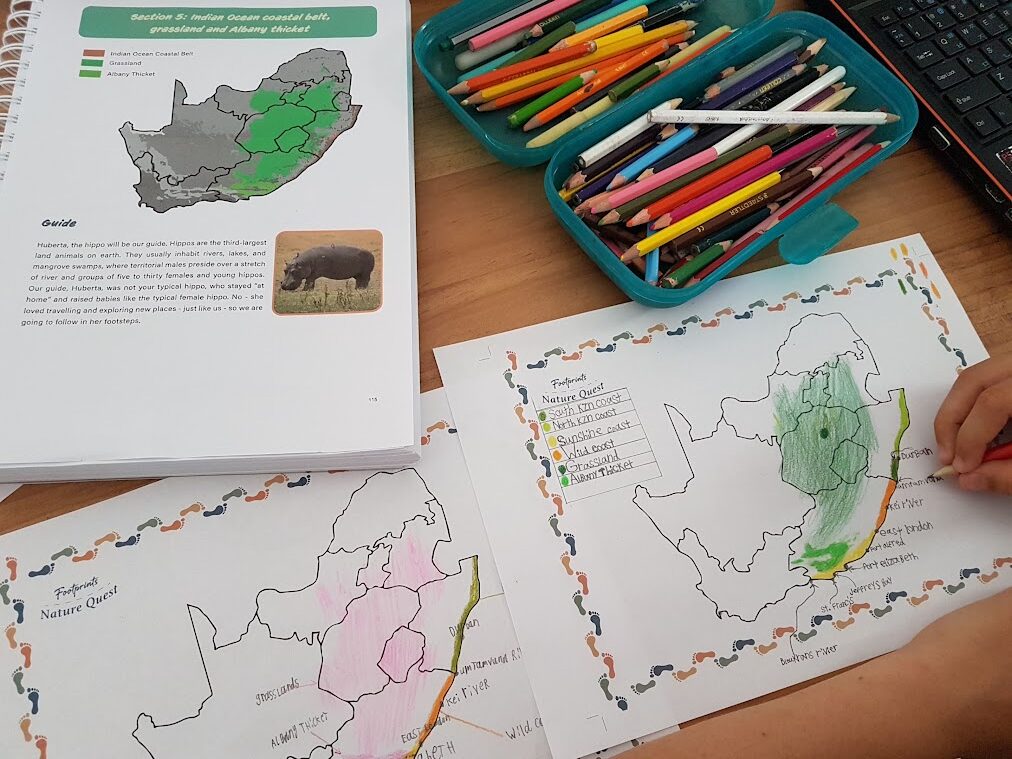
Mapwork plotting the route and regions explored in a story in Footprints Nature Quest
The learning does not have to stop simply because the timetable says it is time for the next subject.
We also believe that a rich education should help South African children understand the country beneath their feet and the significant other feet that left “footprints on our land”. It is wonderful to read about explorers and missionaries on the other side of the world, but our children also need to know the stories of the people, places and events that shaped South Africa. They should know its landscapes, its cultures, its literature, its wildlife, its triumphs and its struggles and have some understanding of the country they are growing up in and the part they may one day play in its future.
The world is their classroom, but South Africa is their home.
That is one of the foundations that has shaped Footprints from the beginning.
CAPS Focuses on Content. Charlotte Mason Focuses on the Child.
CAPS necessarily has to define curriculum content. Charlotte Mason begins with a view of the child:
“Children are born persons,” she wrote.
That means your child is not simply a future examination candidate. Your child is a person who needs knowledge, but also needs to learn how to think, communicate, observe, make choices, form habits and develop strong character.
This is why a Footprints education includes far more than the accumulation of academic facts.
Assessment Differences
South African parents sometimes worry that a less worksheet-heavy approach must mean that it will be difficult to know whether their children are learning. We are all plagued with the question: “Am I doing enough?” but homeschooling gives you the opportunity to observe your child’s learning continuously, a privilege most schoolteachers can only dream of!
When your child narrates a story, you hear what they understand. When they explain a scientific idea, you can tell whether they have grasped it. When they draw something they have observed in nature, you see what they have noticed. When they write, research or complete a practical project, you can assess the quality of their work.
This doesn’t mean that homeschool assessment is a tool for understanding learning rather than the purpose of learning itself.
One of our favourite quotes is
“If the purpose of learning is to score well on a test, then we’ve lost sight of the real purpose of learning.” ~ Jeannie Fulbright
For South African homeschool families who need to demonstrate educational progress, the Footprints programmes can also provide a structured record of the work your child has completed. The important thing is that documentation does not have to dictate the entire educational experience.
Charlotte Mason: Relaxed yet Rigorous
One of the biggest misconceptions about the relaxed atmosphere of literature-rich homeschooling is that it’s not as academically rigorous as other methods. Children are just listening to stories – right?
After more than twenty years of developing and using literature-rich curriculum with South African homeschool families, we have never found that children need endless worksheets in order to learn deeply. What they do need is good material, good questions, time to think and the expectation that they will pay attention and do their own thinking.
A child who listens or reads and then narrates is doing serious intellectual work. A child who discusses an idea is thinking and one who observes nature carefully, records what he sees and researches what he doesn’t understand is learning science. A teen who can recognise that there could be an alternative perspective has learned the fine art of discernment and critical thinking!
Gentle Yet Academically Rigorous: A Return to High-quality, Personalised Education explains how the Footprints homeschool framework, which is rooted in rich literature, narration and personalised learning offers families a return to high-quality education that equips children for tertiary-level study and the demands of the 21st century.
Charlotte Mason’s approach expects children to engage with ideas, books and experiences that are worthy of their attention. The difference is that we want them to learn because they are interested in the world, not simply because a test is waiting at the end of the week.
Charlotte Mason and CAPS at a Glance
| Charlotte Mason | CAPS |
| Child as a person | Learner within a grade-level framework |
| Living books | Prescribed resources and textbooks |
| Narration and discussion | Written activities and formal assessment |
| Connected learning | Separate curriculum subjects |
| Multi-age family learning | Age- and grade-based progression |
| Nature and real-world experience | Curriculum-based science and activities |
| Habits and character woven through life | Values and life skills within the curriculum |
| Flexible pace and presentation | Defined curriculum and assessment requirements |
| Broad, generous education | Structured progression through curriculum content |
| Teaches children how to think | Teaches children what they should know |
The important point is that Charlotte Mason and CAPS are not simply two lists of subjects to compare. They represent contrasting ways of thinking about how education should be organised and what education is ultimately for.
Charlotte Mason vs CAPS: The Differences in a Nutshell
CAPS asks: What should a learner know and be able to do at this grade level?
Charlotte Mason asks: What kind of person are we educating, and how can we give this child a rich relationship with knowledge, ideas and the world?
The two approaches are not necessarily opposites. A child educated through a Charlotte Mason approach can cover, and often far exceed, the knowledge expected by CAPS. We were astonished when we did a thorough comparison of the content requirements: Footprints and CAPS: Astonishing Alignment
The significant difference is how that knowledge is presented, experienced and retained, and what the education is ultimately trying to accomplish.
For Footprints, this distinction is particularly important. We use many of the ideas associated with Charlotte Mason homeschooling because they create the kind of enriching, connected, literature-based education we wanted for our own children, while deliberately bringing South African history, geography, literature, nature, heritage and contemporary life into that broader educational picture.
More about Charlotte Mason Homeschooling in South Africa
Charlotte Mason Homeschooling in South Africa
What is a Living Book? Why Living Books Teach More than Textbooks
Homeschool Notebooking: An Alternative to Workbooks
The Benefits of Literature-based Learning
Gentle yet Academically Rigorous: A Return to High-Quality, Personalised Education
6 Reasons Stories are Better than Textbooks
Homeschooling Multiple Ages: How to Make Multilevel Homeschooling Work