
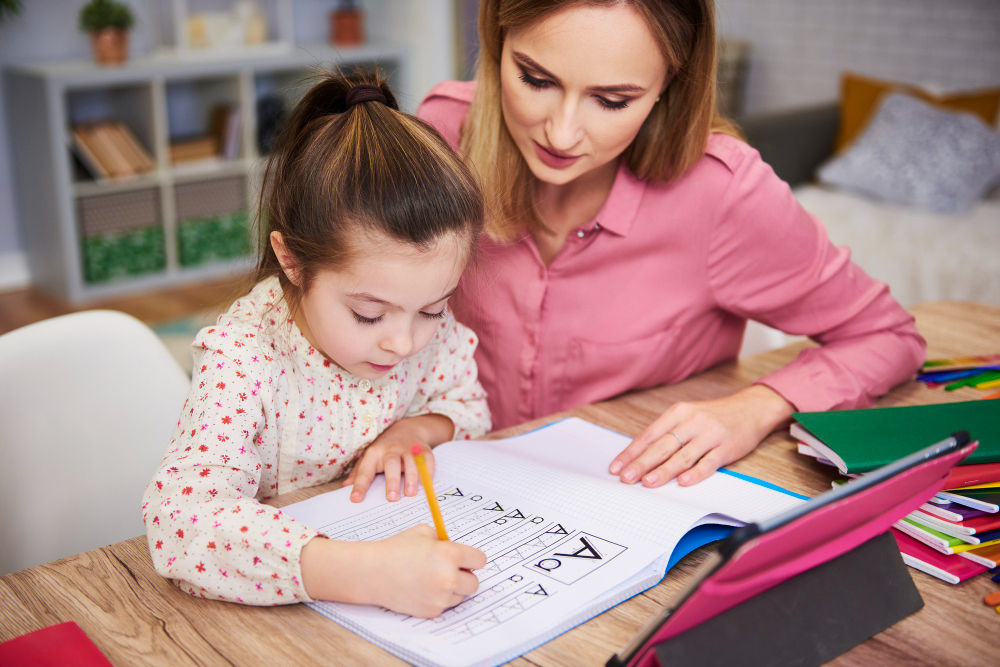
Best practices for learning that Footprints implements seamlessly
Large class sizes, rigid timetables, standardised assessments, CAPS curriculum pacing requirements and administrative pressure make it nearly impossible to implement what educational research has shown, again and again, to be effective.
Homeschooling, when done well, creates the conditions where evidence-based learning practices are not merely ideals but daily realities that empower children to thrive!
The Footprints homeschool curriculum products are intentionally designed to help families consistently apply these four rooted-in-research practices that are a mere dream for school teachers.
1. Relationship-centred, low stress learning
Children learn best when they feel safe, known and supported. Research confirms that strong, secure relationships are foundational to learning. At Footprints, we assume that the parent-child relationship is the core of education. Lessons are designed to be shared, discussed and experienced together, building a treasure of shared experiences, conversations and building trust. In a busy classroom, this intimate relationship is something that teachers can only dream of replicating with the children they teach.
Neuroscience using brain imaging scans shows that positive emotions are essential for learning and that negative emotions adversely affect the parts of the brain responsible for learning. Neurologist Dr Judy Willis reports that extensive research shows learning is most effective when it is enjoyable and connected to learners’ lives, interests and experiences. Enjoyable learning releases dopamine in the brain. This boosts memory and increases acetylcholine, helping learners pay closer attention.(1)
In contrast, stress interferes with memory, attention and executive function in the brain. Many South African children experience chronic stress at school through comparison, testing and performance pressure as well as peer pressure, bullying, labelling and sometimes even verbal or emotional abuse.
Our Footprints programmes were all created to restore joy, family bonding and emotional safety. There are no marks, rankings or constant exam assessments. Your children are free to engage, question and learn by doing without fear of failure.
“We have grown together. There is no stress and happy learning kids.” ~ Shannon Strauss
“Your curriculum has changed our lives and enabled us to have this lifestyle and know my kids are learning loads.” ~ Elanza le Roux
2. The real world is the classroom
Research consistently shows that learning and motivation is best when it is applied in meaningful, real-life contexts.
Footprints integrates learning with everyday life through stories, conversation, practical tasks, outings and real-world exploration.
The world is the children’s classroom, instead of the classroom being their world!
With Footprints, children do not learn merely to please teachers and pass tests. They learn because knowledge is useful, connected and “alive”.
School teachers can seldom pause and pivot a lesson to follow a child’s question or fascination. In contrast, Footprints is built around living books, stories and rich ideas that invite curiosity. When a child wants to linger on a topic, explore a metaphorical (or literal) rabbit trail or connect learning to everyday life, the self-paced curriculum allows time and space for this rather than shutting it down. Read Why Stories are Better than Textbooks
“Footprints is a wonderful, rich learning experience for those who can read the amazing ‘living-books’, research online and go on some relevant outings!…I highly recommend Footprints on Our Land!”
~ Nadene Esterhuizen, ex-teacher and veteran homeschool mother
3. Assessment through understanding, not performance
Research shows that excessive testing undermines internal motivation and increases stress without improving learning outcomes.
Footprints replaces worksheets, tests and formal assessment with narration, notebooking, observation and thoughtful discussion. Parents gain a clear picture of understanding without marks, rankings or comparison, aligning well with South Africa’s flexible assessment requirements.
The CAPS document (which is not compulsory for home educators) states that assessment should be both informal (daily assessments) and formal (tests and exams). Research shows that the reality is that teachers are not using informal assessments much at all and rely mainly on formal testing to assess children’s learning.
Standardised testing data shows that millions of South African children are unable to read or do mathematics at their expected grade level, indicating that the system is failing to meet their needs and that teacher reports and assessments may not accurately reflect each child’s true ability.
In contrast, international homeschool research paints a very different picture for home education. Studies from the United States consistently show that home-educated learners significantly outperform their public-school peers on standardised academic assessments.
“The home-educated typically score 15 to 25 percentile points above public-school students on standardized academic achievement tests (Ray, 2010, 2015, 2017, 2024). (The public school average is roughly the 50th percentile; scores range from 1 to 99.)”
~ Brian Ray, Ph.D., Research Facts on Homeschooling, Homeschool Fast Facts, 9 February 2024
While similar studies have not been conducted in South Africa, there is little reason to believe the outcomes here would be at all different.
Parents care more, you notice more and you respond faster, so don’t underestimate yourself. Stop worrying that you are “not qualified enough” or “not doing enough”. The research says otherwise.
Research shows that feedback is one of the most powerful ways to help children learn—especially when it is quick and clearly tells them what to improve. In homeschooling, feedback happens daily in real time. Instead of the isolated red pen marking of the school system, with Footprints learning becomes relational rather than corrective. Parents can adapt and change to suit a need almost instantly. No lengthy administrative red-tape is required to change the plan.
4. Integrated learning instead of subject silos
The brain does not learn in isolated subjects, instead meaning is created through connection. The famous educator whose teachings are woven into the Footprints programmes, Charlotte Mason, stated that “education is a science of relations”. Most of us struggle to remember information when we’re simply asked to memorise facts. Without connections or personal relevance, the material doesn’t spark emotion or link to what we already know, so we quickly forget it.
Footprints blends history, literature, writing, geography, science, language, art, music, life skills and other enrichment into a coherent, story-driven experience. Children who identify with characters in a well-written story (by famous South African authors) seem to absorb far more. That’s because the facts are tied to living ideas and stories bring those ideas to life. Learning feels whole rather than fragmented, which is something schools struggle to achieve with their inflexible timetables and rigid curriculum constraints.
“I started using Little Footprints with my daughter who is turning six this year. I am a primary school teacher with a literature degree and I have always struggled with the difficulty of incorporating living, engaging thematic learning into disjointed seemingly arbitrary curriculums. Charlotte Mason principles have been a breath of fresh air to my soul. Your programme has given me the most liberating platform and foundation for applying this approach to the rest of her school career.“
~ Bronwen Willams
More research-based homeschool benefits
Homeschooling with Footprints also allows families to implement many other evidence-based practices with ease:
- Children progress at their own pace rather than a schedule determined by bureaucrats.
- Mastery is prioritised over rushing through content. You can track your children’s progress daily and weekly more easily than a teacher and only move on when you know the child has mastered the current lesson or skill.
- Learning follows curiosity without falling “behind”. Your family is not following the same track as other children, so you are never behind!
- Lessons align with ability. Each child’s natural energy, skills, challenges and attention spans can be accommodated in an intimate family environment.
- Fewer lessons are ‘broken’. Classroom learning is often disrupted by announcements, bells, class changes and administrative demands. Although homeschoolers also experience interruptions, they are usually less disruptive and the ‘interruptions’ often offer valuable life lessons.
- Multi-age learning at home is an advantage rather than a problem. Research shows that younger children benefit from observing older learners, while older children consolidate knowledge by teaching. Footprints embraces the reality of multi-age homeschooling families. The curriculum is designed to be used together, allowing siblings to learn alongside one another at different levels of depth. This also makes supervision much easier for parents.
The Powerful Footprints Advantage
Most teachers would love to teach this way. Some were trained to teach this way. What they lack is freedom and the context that allows this kind of learning.
Homeschoolers have that freedom, if we choose to use it.
Replicating school at home (or online) places systemic restrictions on children. Footprints empowers parents to use research-based learning methods effectively, without expecting you to tick in perfect synchrony in someone else’s clockwork machine.
Footprints takes children far beyond the constraints of classroom learning. Rooted in story, relationships, and the rich diversity of South African life, it doesn’t just follow CAPS—it raises the bar, giving children a love of learning, strong academic foundations and a lifelong advantage.
References:
1. Willis, J. The Neuroscience of Joyful Learning, Engaging the Whole Child (online only) Summer 2007 | Volume 64