
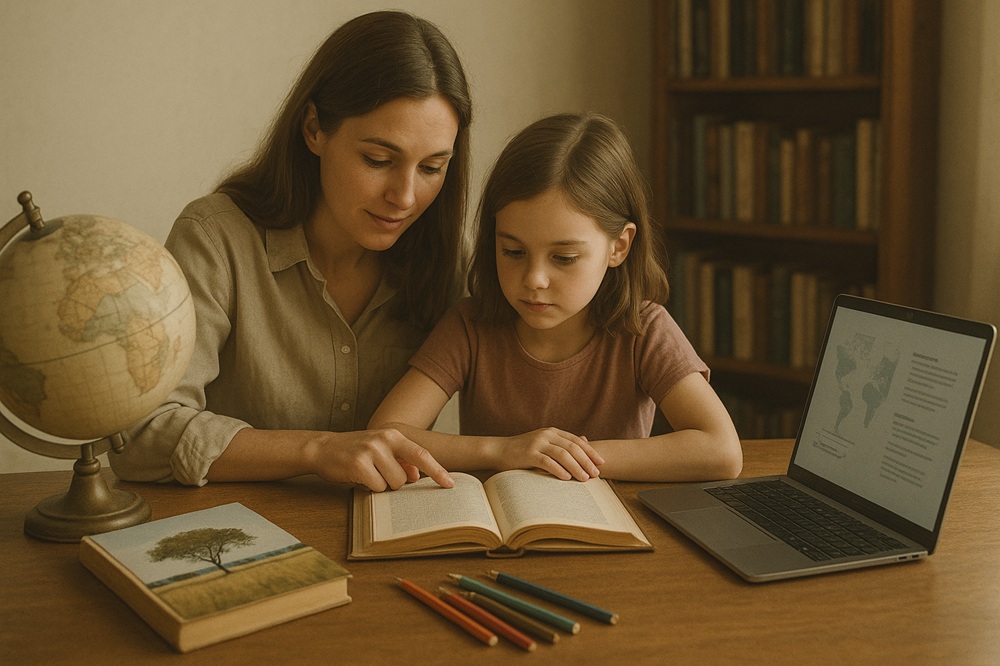
Can stories still shape the future in a world run by machines?
As AI transforms the way we live and learn, many parents are wondering if literature-based learning is still relevant. The answer is “Yes,” and neuroscience backs it up.
Modern research using brain imaging scans shows that what makes learning stick, what shapes a child’s character, imagination and ability to think independently is not the latest app or algorithm, it’s “story”.
In a time of smart machines and digital tutors, it may seem counterintuitive to choose a curriculum rooted in stories and human connection but those very elements are what will make your child more adaptable, empathetic and better prepared for the future, not less prepared. Those are some of the many human qualities and good character traits that machines can never learn, which will make your child stand out from the crowd…and the AI!
Stories are How the Brain Learns Best
Modern neuroscience has confirmed what educators and storytellers have known for centuries: our brains are wired for story.
When children engage with a narrative, whether it’s a Biblical parable, a tale of Voortrekkers on the veld or a historical account of World War heroes, multiple regions of the brain light up. Language centres, sensory processing areas and even emotional memory centres are activated. Children experience the story in an imaginary simulation.
Unlike rote memorisation or fragmented worksheets, stories stick. When your children read about a young boy on the Eastern Cape frontier or follow the journey of a girl hiding during the Anglo-Boer War, they are not just learning history. They are living it in their imaginations. Through characters and real events, they begin to understand courage, sacrifice and moral complexity.
No worksheet or AI chatbot can replicate the power of that.
In an era where information is infinite but wisdom is rare, story-based learning is not outdated, we believe it’s essential.
South African Stories that Anchor Identity
In a country as diverse and richly layered as South Africa, our stories matter even more. They help children understand where they come from, how different communities shaped this land and why their voices matter.
Footprints has always woven these threads into its pages. Whether your child is tracing the steps of early settlers and indigenous peoples or discovering the faith in action of Emily Hobhouse or Steve Biko, they are absorbing values that last. They are considering the issues, the choices that historical or fictional characters had to face and the outcomes of those decisions.
This kind of learning builds roots. It gives children a framework for belonging and a foundation to grow into thoughtful citizens who don’t just consume content but question it, challenge it and improve it.
From “Invisible” to a Validated Cultural Heritage explains how important it is to help families reconnect with their roots, recognise their own significance, celebrate every culture’s contribution and inspire children to see themselves in the nation’s story.
AI is a Tool. You are the Teacher.
Artificial intelligence is not going away. It can help children research faster, explain difficult concepts in new ways or simulate scenarios for problem-solving. In the right hands, it can boost curiosity and capability.
What it cannot do is love your child. It cannot pause to ask, “How did that story make you feel?” or notice the glimmer in a child’s eyes when he finally grasps something deep. That is your role and it is irreplaceable.
“There is no genius in Silicon Valley who has yet devised a machine half as effective for teaching and nurturing the young mind as a flawed, fallible, physically present human being.” ~ Meghan Cox Gurdon, The Enchanted Hour
Footprints was designed to preserve and build this sacred connection between parent and child. Learning happens in real conversations around the kitchen table, during read-alouds on the couch or while walking through a museum in your hometown. These moments build not only knowledge but also values, morals and stronger relationships.
Raising Future-Ready Leaders, without Losing the Past
Children raised on real books, meaningful discussions and historical context are not being left behind. They are being equipped to lead in ways that machines never can.
AI might outperform humans in data crunching, but it cannot discern right from wrong. It cannot choose compassion over convenience or integrity over profit.
A leading corporation implemented AI to handle customer enquiries. It could answer many of the questions but the customers hated it. Wisely, the company ditched it and instead trained human staff to listen, to express empathy and to show they care and the result?… the customer ratings skyrocketed.
These are the kinds of decisions that tomorrow’s leaders will face and they will not be based on data alone, but insight, character and a deep understanding of human nature.
When your children read a story about a boy who stands up for what is right or a girl who quietly resists injustice, they are rehearsing the kind of moral courage the future needs.
They are not just learning. They are becoming. When your child reads about brave boys and strong girls navigating challenges…when they see flawed characters rise above fear or failure…they start to believe they can make courageous choices too.
We believe raising children in the 21st century doesn’t mean abandoning the past. It means weaving together the best of both worlds—old wisdom and new tools, timeless values and future-forward skills. Yes, the world is changing fast, but what will always matter is how children think, care and respond to the world around them.
History is Boring. Your Heritage is Alive! explains how instead of a sanitised textbook version of history real story-driven history makes history personal as children uncover their family heritage, connect with the past and discover their own place in South Africa’s complex story.
Children need both roots and wings. Stories give them roots. They anchor them in truth, identity and history. Thoughtful engagement with new tools like AI gives them wings, it opens possibilities for creativity, innovation and global impact.
You do not need to choose between tradition and technology. You only need to stay faithful to what matters most: connection, curiosity, character and Christ-centred values.
AI may be able to generate answers, but your child’s story is one only they can write.
Let the machines handle the data. Let the stories shape the soul.
Ready to future-proof your child with the power of story?
Explore Footprints today—where real books, real conversations and real growth are still the heart of home education.
We know that no one chooses home education because it’s easy, but rather because we believe that it’s worth the investment of time and energy into shaping our children’s lives.
If you could use a little reassurance, perspective, and peace in your inbox, sign up today, because sometimes, the smallest words of encouragement are exactly what keep us going.
Join the Footprints community and get your Nurture Nuggets today, packed with tips and advice from moms with over 25 years of home education experience.
Sign up today, so you don’t miss the next issue.
Also read…
How to Ensure Deep Learning in an Age of Digital Distraction
Although we live in an ever-advancing technological era with space-age breakthroughs that are revolutionising the way we live and work, the human brain is still hard-wired to learn as it did in ancient times. As homeschoolers we can harness the power of technology in our world and yet still benefit from the time-tested methods of learning that best suit the way our brains were created.
Give your children a 1.4 million word advantage
Discover one thing parents can do to catapult their children’s language and concentration skills to give them a lifelong academic advantage.
Six Reasons Stories are Better than Textbooks
Most of us think of education as learning facts from textbooks, (or the online equivalent) because that’s how the school system works and that’s probably the limit of our own experience …until you start homeschooling …and then you realise that there are multiple other ways to learn that are far superior…
From “Invisible” to a Validated Cultural Heritage
Exploring South African history from multiple perspectives helps families reconnect with their roots, celebrate every culture’s contribution and inspire children to see themselves in the nation’s story. It’s a vital experience because, no matter our race group, our history is the foundation of identity, belonging and understanding.