
How Footprints Empowers Families of all Races to Discover Identity and Belonging
In South Africa, history has often been told through a narrow lens — one that highlights certain voices while silencing or diminishing others. Yet, beneath the layers of official narratives and textbook timelines lies a far richer, more intricate story of who we are as a nation. When we explore history from multiple perspectives, we uncover the shared threads that connect us all. Families begin to rediscover their own roots, reclaim their stories and see themselves reflected in our nation’s journey.
At Footprints, we believe that history is not simply a subject to be studied.
Our history is the foundation of identity, belonging and understanding.
When children learn history that acknowledges every population group’s contribution — Black, White, Coloured, Indian and others — they begin to see how their own family’s story fits into the grand narrative of South Africa.
For many Coloured families, that story has long felt incomplete. They are part of an officially recognised multi-ethnic group, yet many express feeling “invisible”— not Black, not White, uncertain of where they belong in the country’s complex racial tapestry. Their origins are deeply intertwined with the earliest days of the Cape: descendants of Khoena and San peoples, of enslaved Malays and Indians and of unions between Black Africans and European settlers. Their story is not one of absence or confusion, but of resilience, adaptation and contribution.
We have seen, time and again, how acknowledging this truth brings healing. At a recent education expo in Cape Town, co-author of Footprints, Wendy Young, met a Coloured mother who initially approached our stand with frustration and suspicion. She was tired of seeing her culture and history overlooked or sidelined. Yet, as Wendy showed her how Footprints recognises and celebrates the Coloured community’s origins, their role in the early Cape settlements, their struggles through colonial slavery and apartheid times and their ongoing contributions to modern South Africa, her anger dissolved into tears. For the first time, she saw her story and her culture validated. She realised that her ancestors were not forgotten footnotes but active participants in shaping the country we live in today.
This is the power of inclusive storytelling. When we tell the whole story, the beautiful, the painful and the complex, we make space for every child to see themselves in history’s pages. Families begin to ask new questions: Who were our ancestors? Where did they live? What part did they play? These questions spark curiosity, research and often, a sense of pride that transcends the labels imposed by history.
Exploring history from multiple perspectives does more than fill gaps in knowledge. It builds empathy and unity. When children understand that the land they walk on was once traversed by Khoe herders, San hunters, Malay artisans, Indian traders, European farmers and African chiefs, who all left their mark, they begin to appreciate the shared humanity that binds us.
By engaging with history this way, parents and children alike are empowered to reclaim their narratives. They move beyond inherited stereotypes and begin to see their heritage as a source of strength. Whether through family discussions, community research or literature-based learning, every South African family can contribute to restoring the fuller, truer picture of our past.
At Footprints, this is what we strive to do. We make history come alive through stories that honour all people because when our children grow up knowing where they come from and recognise the significance of every culture in shaping our nation, they are better equipped to build a future rooted in respect, understanding and shared pride.
The stories we share truly do change lives — one family, one conversation and one rediscovered heritage at a time.
If you’d like your children to discover where they come from and to see how every culture shaped our nation’s story, explore the Footprints homeschooling programmes. Each one weaves together South African history, literature and storytelling to help families connect with their heritage and find pride in their roots.
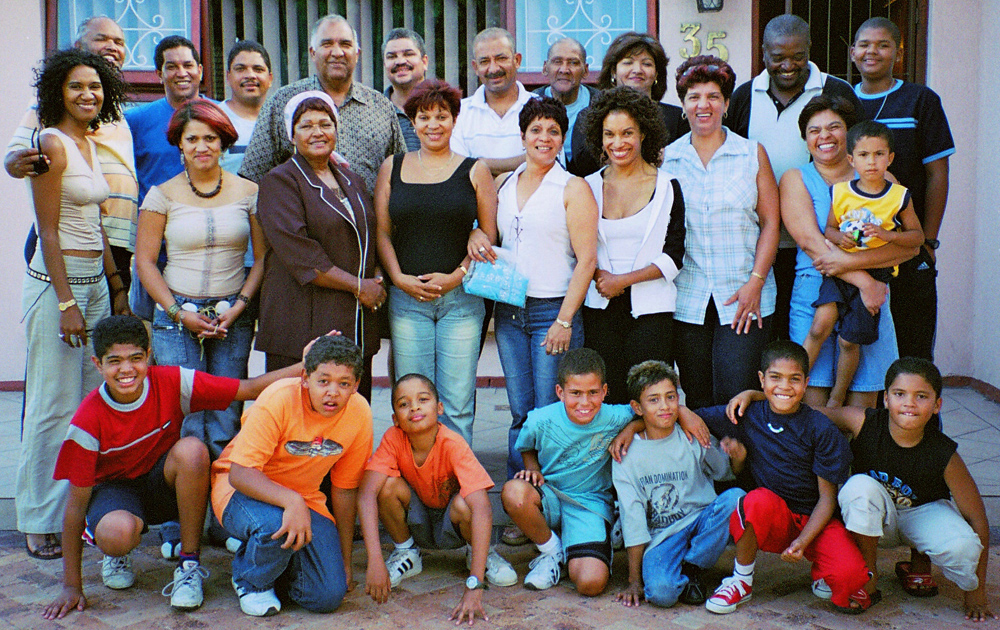
Photo: An extended Coloured family with roots in Cape Town, Kimberley and Pretoria, at Christmas 2000. They comprise the Binghams, the Abrahams, the Bayards and the Fortunes.
Read more
Why Story-Driven Learning is Still Essential in a World Driven by AI
Discover why story-driven, literature-rich learning is more relevant than ever in the age of AI. Neuroscience confirms what Footprints families already know: real books, meaningful conversations and human connection still shape future-ready children.
Why Footprints is Better Than CAPS for South African Homeschoolers
When it comes to educating your children at home, the curriculum you choose can either ignite a love of learning—or snuff it out entirely. For many South African families, the default option seems to be CAPS-based online school services, simply because it’s what schools use. But as more parents discover the freedom and flexibility of homeschooling, they’re realising that school-at-home isn’t necessarily the best fit for home education.
Explore More South African History Homeschool Articles

- Why Study the History of South Africa?
- History is Boring. Your Heritage is Alive!
- Making Dead Guys Come Alive: How We Study the History of South Africa
- From “Invisible” to a Validated Cultural Heritage
- 6 Reasons Stories are Better than Textbooks
- Honouring the Legacy of the Women’s March
- South Africa Travel – Footprints Around SA
- A South African Garden Route Trip
- South African History: Homeschool Unit Studies
We know that no one chooses home education because it’s easy, but rather because we believe that it’s worth the investment of time and energy into shaping our children’s lives.
If you could use a little reassurance, perspective, and peace in your inbox, sign up today, because sometimes, the smallest words of encouragement are exactly what keep us going.
Join the Footprints community and get your Nurture Nuggets today, packed with tips and advice from moms with over 25 years of home education experience.
Sign up today, so you don’t miss the next issue.