

Considering homeschooling through high school? Explore the pros and cons of high school homeschool in South Africa and popular matric alternatives like Cambridge, GED and the American High School Diploma.
While reaching high school level is an exciting milestone, it is completely normal to feel a sudden wave of uncertainty as your child enters adolescence.
Between complex academic subjects, like high school algebra, chemistry and literature analysis, and navigating the changing dynamics of parenting a teenager, many parents begin to second-guess themselves. The prospect of teaching advanced topics or handling moody pushback can make even experienced home educators feel overwhelmed.
However, the high school homeschool years can actually be one of the most rewarding and fulfilling seasons of your family’s educational journey.
With the right mindset and flexible learning tools, high school at home offers unique advantages that traditional classrooms simply cannot match. From customisable matric alternatives to one-on-one instruction, homeschooling empowers teens to gain independence, pursue their interests and prepare for higher education, all within a supportive, family-centred environment.
Common Worries About High School Homeschool
1. “I’m not qualified to teach high school-level subjects.”
Many parents worry that they won’t be able to keep up with the academic demands of high school. But homeschooling in the 21st century doesn’t mean doing it all alone. Online courses, tutoring services, video-based curricula and even community classes can help fill in any gaps. By high school level, most homeschooled teens have developed independence and are used to self-study. Your role becomes supervisor and cheerleader, rather than ‘teacher’.
2. “My teen and I will clash too much.”
If you’ve trained your child’s character in the early years, then the emotional ups and downs of adolescence will feel more like bumps in the road rather than a rollercoaster of conflict. Learning to navigate conflict in relationships is a skill we all need. Avoiding it by sending children (back) to school helps no one. High schoolers also appreciate autonomy and respect. Homeschooling gives teens space to co-create their learning path, which often diffuses power struggles and deepens the parent-teen relationship over time.
3. “My child won’t be socially prepared.”
The myth of the “unsocialised homeschooler” continues to linger, but it’s rarely true, especially in the teen years. Homeschooled high schoolers often engage with a wide range of people through sports, volunteering, youth groups, and co-ops, giving them richer and more meaningful homeschool socialisation experiences than same-age peer grouping alone. You may need to work a little harder to build these connections, but it’s no reason not to continue homeschooling.
The Many Benefits of Homeschooling High School
Despite initial fears, parents often find that the high school years at home allow their teens to thrive in ways that traditional schooling simply can’t match:
1. One-on-one tuition
Whether it’s extra help with maths or a deep dive into history, homeschoolers benefit from tailored instruction that adapts to their pace and learning style.
2. Special needs and abilities are accommodated
Students with learning challenges or giftedness aren’t boxed into a one-size-fits-all system. Homeschooling offers the freedom to adjust materials and methods for maximum success.
3. Building family relationships
Teen years don’t have to be defined by distance or rebellion. Homeschooling can nurture closer connections, deeper conversations, and more shared experiences. Conflict with your Homeschooled Teen presents opportunities to learn better relationship-building skills and build stronger character.
4. Less negative peer pressure
Without the constant comparison and conformity of school culture, teens often feel freer to develop their own identities and values. They are protected from potential exposure to drugs, bullying, obedience training, authoritarianism and the consumer culture and other vices of the single age peer group, so typical of most schools.
5. Reinforcing moral and religious beliefs
Home education allows families to shape their teens’ worldview through thoughtful discussions, literature, and experiences aligned with their beliefs.
6. Better socialisation
Homeschooled teens often engage in mixed-age interactions, developing communication skills, empathy, and maturity through broader, real-life social experiences.
7. Pursuing passions
Homeschoolers can dedicate time to creative, entrepreneurial, or academic passions. They have time to develop portfolios, businesses, or skills far ahead of their peers.
8. Better use of time
Without hours lost to commuting, assemblies, or busywork, homeschoolers have more productive, focused school hours and ample time for rest or enrichment.
9. Flexibility
Travel, internships, part-time jobs, or mission work become possible with a flexible homeschooling schedule.
10. Healing from negative experiences
For teens who’ve been bullied, burnt out, or overlooked in the school system, homeschooling offers a chance to rebuild confidence and rediscover the joy of learning.
Tailoring High School Homeschooling to Your Child
No two teens are alike, and that’s the beauty of home education. Parents have the unique opportunity to design a high school journey that reflects their child’s strengths, values, and future goals. Whether your teen dreams of university, entrepreneurship, the arts, or vocational work, your homeschool can be shaped to fit those aspirations.
Don’t let fear of failure hold you back. Children are incredibly resilient and more often than not, what matters most isn’t having all the right textbooks or credentials. It’s having adults who believe in them, who listen, who adapt and who are willing to walk alongside them as they grow.
Home educators generally succeed as young adults because they have developed the character, integrity, work ethic and motivation to achieve their goals.

You won’t “mess it up.” You’ll simply be modelling lifelong learning, as you learn alongside your teen, which is perhaps the most important lesson of all.
As our many homeschool success stories show, other families have done it and there is no reason that you can’t navigate the high school years beautifully too.
Our article, Personalised Homeschooling Grades 8-9 suggests a selection of homeschool curriculum resources you could use to build a self-paced, flexible programme for the early high school years, before you select the school exit option that will follow.
Popular High School Homeschool Options for South African Homeschoolers*
When it comes to official certification, South African homeschoolers typically consider these well-supported alternatives:
1. Cambridge (IGCSE and AS Level)
- Internationally respected and academically rigorous.
- Ideal for students aiming for competitive university entry (local or international).
- Requires strong self-discipline and often parental/ tutor involvement.
- Assessments are exam-based with set sittings in May/June or Oct/Nov.
2. GED®
- American high school equivalency recognised in South Africa by SAQA (after evaluation).
- Test-based, flexible, and self-paced.
- Popular for students seeking alternative tertiary routes or skills-based careers.
- Offers a quicker and often more affordable path to a recognised school-leaving qualification.
- Also read GED vs American High School Diploma: Which is best for your child?
3. American High School Diploma (via umbrella schools)
- Offers a credit-based system with recognition of real-world learning and personalisation.
- Accepted by many international universities, especially in the US.
- Ideal for students who want flexibility and breadth without the intensity of Cambridge.
- Also read GED vs American High School Diploma: Which is best for your child?
*Always check university admission requirements and make sure that your chosen pathway will be accepted to achieve your goals. Check the specific faculty at each institution as their entry requirements may differ from the legally required minimum.
Note:
We do not recommend pursuing the CAPS-aligned NSC matric through homeschooling. School-at-home replicates the very system many families choose to leave, often adding stress without providing meaningful advantages. Homeschooling is at its best when it embraces a flexible, child-centred approach.
How CAPS Sabotages Learning and How Footprints Restores it with Joyful, Purposeful Education
Why Footprints is Better than CAPS for South African Homeschoolers
Why Footprints is Better than Online Schooling
High School Homeschool Consultations
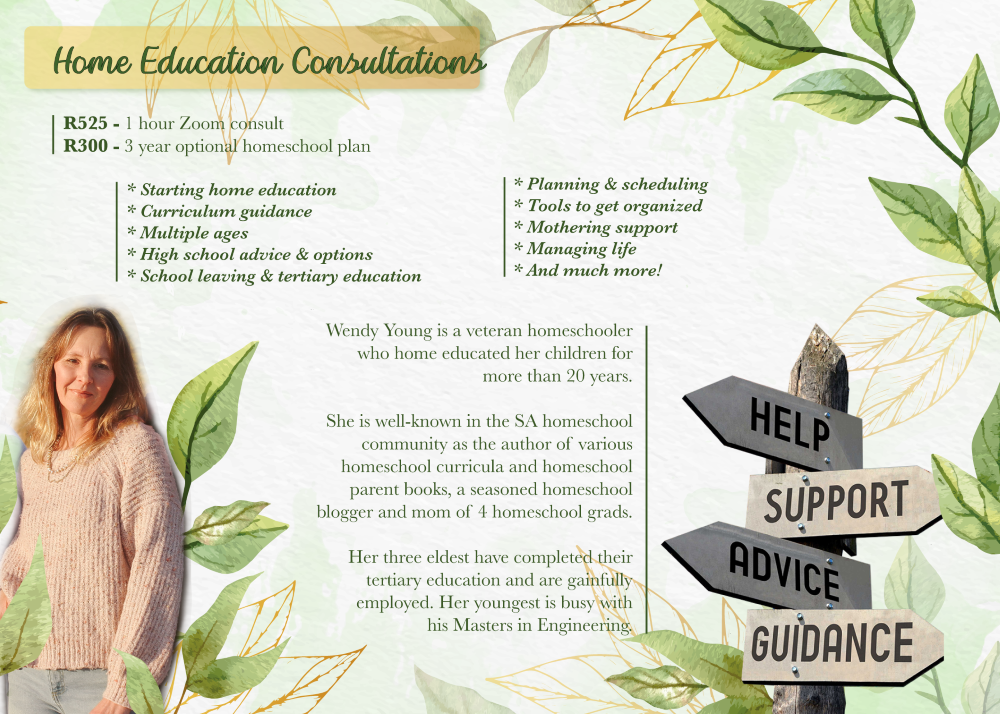
If you are still feeling unsure or need advice about which school-leaving pathway to choose for your child, consider investing in a face-to-face online homeschool consultation with Wendy Young. Having guided her own four children through various different pathways, she has first hand experience of meeting the needs of each unique child. Her vast knowledge and insight can help you make the right decision for each of your children. Book a homeschool consultation.
High School Homeschool FAQs
Frequently Asked Questions About Homeschooling High School
National Senior Certificate (NSC): If a student is pursuing the local NSC, continuous assessments (SBA) and examinations for Grades 10–12 must be managed and conducted by an accredited curriculum service provider offering a CAPS-aligned programme (such as SACAI or IEB-aligned assessment bodies).
American High School Diploma (AHSD): Earning an AHSD relies on a credit-based continuous assessment system rather than a single high-stakes exit exam. An umbrella school (like HomeLife Academy) evaluates parents' records, coursework, portfolios or online course grades to verify that high school credits and GPA standards have been achieved across Grades 9–12.
Cambridge International (IGCSE & AS/A Levels): Assessment is almost entirely exam-based. Students write standardised, externally set and marked exams at accredited Cambridge examination centers in set sittings (May/June or October/November).
GED®: Rather than evaluating years of high school coursework, the GED assesses high school equivalency through four computer-based tests (Mathematical Reasoning, Science, Social Studies and Reasoning Through Language Arts) written at official testing centers.
Regardless of the route, parents transition into the role of supervisor and record-keeper, ensuring their teen meets the specific assessment and transcript criteria of their chosen qualification.
Preparing Young Adults
We always say, “We’re not raising children, we’re raising adults!”
Homeschooling high school isn’t about trying to replicate school perfectly—it’s about reimagining education for your unique child. With the right support, tools and mindset, these years can become a time of discovery, growth and preparation for a meaningful future. Trust your instincts. You are the expert on your child.
And remember, thousands of families have walked this path before you and found it to be more than possible. You can do it. You should do it!
Footprints /Voetspore programmes for High School Homeschooling
Rooted in rich literature, narration, and tailored learning, the Footprints research-informed framework balances a gentle approach with high academic standards. It provides families with a high-quality home education designed to prepare students for university success and modern challenges. Footprints is Gentle Yet Academically Rigorous: A Return to High-quality, Personalised Education
All these programmes are accepted as credit-earning courses towards an American High School Diploma. They also build an excellent foundation for children who, like our own did, pursue either Cambridge or the GED as their matric alternative exams.
Read our article: Why Footprints Programmes Prepare Your Child for More Than Just Matric
Footprints – The Early Years / Voetspore 1
Although originally designed for younger learners, this recently updated rich, literature-based programme is suitable for high school students. It’s ideal for those needing a gentle reintroduction to learning or a healing start after negative schooling experiences. It’s a good choice for students who need confidence-building, creative thinking and a South African foundation in history and culture. Perfect for older students who missed out on the early years of home education.
Footprints – The Last Century / Voetspore 2
A comprehensive exploration of 20th-century South African history through stories, biographies, and projects. Suitable for high schoolers needing Social Studies or History credits, this programme encourages critical thinking, empathy and engagement with real-world events. A strong foundation for further study in Social Studies, Language Arts, Writing and more.
Footprints Nature Quest / Natuurskattejag 1 and Natuurskattejag 2
Designed for ages 10 and up, this integrated programme weaves together Natural Sciences, Language Arts and Environmental Literacy through captivating stories and hands-on activities. It’s ideal for high schoolers pursuing GED Science prep or needing flexible credits in Science, English, or Life Orientation. Natuurskattejag 1 and 2 are the full Afrikaans versions, offering the same immersive and experiential learning in a culturally relevant way.
High School Homeschool Science
We recommend the Apologia High School Science programs. These are Christian homeschooling science curricula which will open your children’s eyes to God’s awesome creative powers evident in the world around them. Choose from General Science, Physical Science, Biology or Chemistry. Read more at High School Science Programmes
Proof of Success: Homeschool Graduates Thriving beyond High School
If you are still wondering whether homeschooling high school will open doors for your child’s future, rest assured that home-educated students go on to achieve great things. Over the years, many homeschooled high school graduates have successfully transitioned into university degrees, vocational qualifications, creative careers, and entrepreneurial ventures. From mastering self-directed study to building resilience and real-world confidence, home education equips young adults with the exact skills needed to excel in higher education and adult life.
Read inspiring real-life journeys on our Homeschool Success Stories page to see where homeschooling can take your teen!