

In a world where families are being pulled apart by the pressures of modern culture, home educators stand as courageous architects of the future. They are not simply teaching children at home, instead they are reshaping society, nurturing independent thought and raising a generation capable of leading with conviction and purpose. Charlie Kirk recognised this power, championing homeschooling as a bold path to cultivating character, intellect and the resilience our world desperately needs.
In an online clip “Are Homeschooled Kids ‘Weird’ or Wise?” (included below), when asked what he would say to people who oppose homeschooling, Kirk claimed that critics might one day be applying for jobs from homeschooled students! He described homeschooled children with a multitude of positive attributes: “more polite, smarter, wiser, happier, more purposeful, less corrupted, more understanding, more battle-ready, better prepared, less confused, more biblical, more grounded, more Christ-like,” …than their school-going peers, is the implied comparison.
He urged parents to homeschool if possible, making the case that stereotypes about homeschoolers being “weird” are wrong. Instead, he proclaimed that they are the wise, who will be likely to run society (or hold leadership) in the future.
Charlie Kirk’s claim that homeschoolers will be the future leaders rests on several interconnected ideas and we’ll present researched data to support his views.
Charlie Kirk’s Rationale for Homeschooling
He believed that homeschooling gives parents the ability to shape their children’s values in a way that is not always possible in conventional schools. In his view, this produces young people who are more grounded in moral and spiritual principles, which he considered as essential for guiding others.
He also argued that homeschooled children tend to grow up with stronger character and clearer purpose. According to Charlie, they are less exposed to harmful influences, less confused about their identity and more prepared to face the challenges of life. This, he suggested, equips them to step naturally into leadership roles.
A research report by Michael Brady entitled Social Development in Traditionally Schooled and Homeschooled Children, a Case for Increased Parental Monitoring and Decreased Peer Interaction confirms this view that home educated children are protected from harmful influences: “There seems to be an overwhelming amount of evidence that children socialized in a peer-dominant environment are at higher risk for developing social maladjustment issues than those that are socialized in a parent monitored environment.”1 [our bold for emphasis]
Another part of Charlie’s reasoning is that homeschooling fosters better academic results (more on this follows), emotional well-being and mental clarity. When combined with a solid moral foundation, these advantages create a generation that he believed would be better suited to direct the course of society. Charlie referred to himself as an autodidact, (a self-taught person) as his post-school education was largely self-education.
Underlying all of this is a critique of mainstream education. Kirk implied that public schools fail to nurture these desirable qualities and that homeschooled children would stand out in contrast. Because the home educated have generally been raised in an environment that encourages responsibility, purpose and conviction, he concluded that they are the ones most likely to lead in the future.
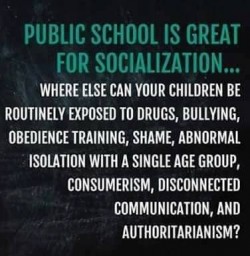
A meme shared virally on social media some years ago, sums up the many negative aspects of public schooling that Kirk also typically highlighted. It asks: “Where else can your children be routinely exposed to drugs, bullying, obedience training, shame, abnormal isolation with a single age group, consumerism, disconnected communication and authoritarianism?”
Homeschool Research — Does the Data Support Kirk’s Views?
Let’s look at what the research says. There is very little international research on home education but the data from the USA, published by the National Home Education Research Institute is likely to be similar in other countries, such as South Africa.
1. Who is homeschooling and how many?
There were about 3.1 million homeschool students in grades K-12 in the USA in 2021-2022. That’s up from about 2.5 million in 2019. Homeschool families are quite diverse. About 41% are Black, Asian, Hispanic or non-white in the U.S. Homeschooling is not just a “white family thing.”
2. Academic achievement
This is very convincing evidence! On standardised achievement tests, home-educated students typically score 15 to 25 percentile points above public-school students. Black homeschool students in particular scored 23 to 42 percentile points above Black public school students in a 2015 study. These higher scores occur regardless of parents’ formal education level, income or whether parents were certified teachers…so it’s not just ‘privileged’, rich homeschoolers who achieve academically!
3. University and adult life success
Many homeschooled students go to college/university. Some studies show that a large proportion of them complete some college courses and many are full-time college students by early adulthood. Homeschooled students tend to be doing “essentially equivalent” or better compared to their peers at university, coping with academic stress and social pressure.
4. Socialisation, self-esteem, psychological health
On many measures such as peer interaction, leadership, self-concept, self-esteem, homeschool students tend to be above average compared to public school peers. In a study of children aged 8-12, homeschooled kids outscored or equalled peer-schooled and private school groups in social skills and satisfaction with their social relationships. On cooperation, empathy, assertiveness and self-control, homeschool children generally match or exceed their public school peers.
In his Ph.D. research, Larry Shyers observed children from public, private and home education settings during both free play and structured activities. Independent clinical psychologists, unaware of the children’s schooling backgrounds, evaluated their behaviour. Shyers discovered that homeschooled children matched their school-going peers in almost every area of social interaction, with one notable difference: they exhibited fewer problem behaviours!2
5. Ideological tolerance
Albert Cheng, a researcher at the University of Arkansas, studied the political tolerance of college students who had been homeschooled compared with those who had not.
Cheng defined political tolerance as “the willingness to extend basic civil liberties to political or social groups that hold views with which one disagrees.” The findings revealed that homeschooled students were more politically tolerant, and that the more years a student had been homeschooled, the higher their level of tolerance compared with peers from public schools.
Education is an Ideological Arena
Ultimately, the conflict is about who shapes children’s values. Parents have a constitutional right to direct their children’s education, yet activists and officials often aim to supplant that role with government messaging, telling children what to believe rather than teaching them how to think, which is a defining feature of authoritarian control. This problem is not only inherent in the USA, it’s the same in countries across the globe.
Here in South Africa, it is no different. Education has been described here as “a political game” in which, “We are gunning for the same South African citizen.” Children should be “be properly formed and moulded to our revolutionary ideas.”3
Charlie’s life’s work demonstrated that education is indeed a political game. He entered bravely into this ideological arena and although an intolerant opponent took his life, the bullet engraved with man’s words ironically served only to amplify the eternal Truth that Charlie spoke. Instead of silencing him, it gave his voice a megaphone that is resonating around the world.
Home educators are indeed potential leaders and world changers. They are redefining education and re-establishing the boundaries of work, school and family life and raising children who will lead with integrity, think boldly and leave a lasting mark on the world.
References:
- Home School Researcher Volume 15, No. 4, 2003, p. 11-18, https://www.nheri.org/pdfs/154B.pdf, accessed 19 September 2025 ↩︎
- https://archive.org/details/comparisonofsoci00shye, page 205, accessed 19 September 2025 ↩︎
- On 20 May 2004, Ms. Mmule Madonsela, a senior official responsible for home education in Gauteng, told a meeting of homeschoolers in Johannesburg: ‘Education is a political game’.
On 10 April 2004, her senior, Ms. Tidimalo Nkotoe, stated in a Carte Blanche TV programme that home education must be controlled, because uniformity is the goal: “We are gunning for the same critical outcomes. We are gunning for the same South African citizen.”
On 20 October 2005, Mr. Siphosezwe Masango, MEC for education in Mpumalanga, addressed a meeting of what he termed ‘fellow combatants’. It was in fact a congress of the teachers’ union, SADTU. Masango encouraged teachers to indoctrinate children to “be properly formed and moulded to our revolutionary ideas“. ↩︎